
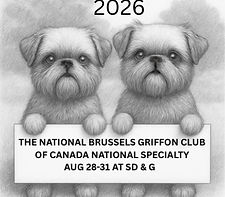


Lots of Extra fun things to do with your dog 0n the specialty weekend!
The premium List is now available on Canuck Dogs website, with all additional details for all these events.
www.canuckdogs.com

Please join us for a Griffnic after our Specialty and please bring a sharable contribution.
Get ready for an outstanding experience at the National Brussels Griffon Club Specialty Show this year, which is being held at Stormont, Dundas and Glengarry Dog Association on August 30th with Confirmation shows held August 28th to 31st.
Find essential information, guidelines, and resources to help make your participation seamless and successful.
Our Judge for the Specialty will be Valeria Rickard (USA)
Valeria's passion for dogs began during her youth in
Europe where she started off in junior handling. There, she
bred her first litter of Airedales - sired by her own
champion male. After moving to the U.S., and completing
her education and graduated with honors in 2001 from
Virginia Tech, earning her DVM degree. Even during that
final year of college, soon to be doctor Rickard had already
rekindled the flame by acquiring her new foundation bitch
Airedale and restarting her breeding program. She also was
involved with breeding Welsh terriers, finishing several
champions, before focusing on breeding Airedales.
Dr. Rickard's near life-long interest in purebred dogs and
her extensive medical knowledge has motivated her to
become an AKC conformation judge. To her credit, Dr. Rickard's accomplishments, her
impartiality and known eye for quality has already led her to have been contacted by
Airedale clubs from around the world to judge at their breed specialties.
Dr. Rickard has been published in two veterinary textbooks and often donates her time by
conducting seminars and presentations on canine reproduction, pediatrics, and related
topics. She is frequently published in magazines such as Terrier Type and other newsletters.

National Brussels Griffon Club of Canada
Breed Standard
General Appearance
A toy dog, intelligent, alert, sturdy, with a thick-set short body, a smart carriage and set-up, attracting attention by its almost human expression.
Size
For the class of dogs and bitches of a small size, the weight should not exceed 7 lb. (3 kg).
For the class of dogs and bitches of a large size, that is weighing more than 7 lb. (3 kg), the weight should not exceed 11 lb. (5 kg)
for dogs and 12 lb. (5.5 kg) for bitches.
Note: Type and quality are of greater importance than weight, and a smaller dog that is sturdy and well proportioned should not be penalized.
Coat and Colour
DThere are two distinct types of coat - rough and smooth. The rough coat should be wiry and dense, the harder and more wiry the better. On no account should the dog look or feel woolly, and there should be no silky hair anywhere. The coat should not be so long as to give a shaggy appearance, but should still be distinctly different all over from the smooth coat. The head should be covered with wiry hair, slightly longer around the eyes, nose, cheeks, and chin, thus forming a fringe.
The smooth coat is similar to that of the Boston Terrier or English Bulldog, with no trace of wire hair. In the rough-coated type, coat is either: (a) reddish brown, with a little black at the whiskers and chin allowable, or (b) black and reddish brown mixed, usually with black mask and whiskers, or (c) black with uniform reddish brown markings, usually appearing under the chin, on the legs, over the eyebrows, around the edges of the ears and around the vent, or (d) solid black. The colours of the smooth-coated type are the same as those of the rough-coated type.
Any white hairs in either the rough or smooth coat GROUP V TOYS V-7 are a serious fault, except for “frost” on the black muzzle of a mature dog, which is natural.
Head
Skull large and round, with a domed forehead. Nose very black, extremely short, its tip being set back deeply between the eyes so as to form a lay-back. The nostrils large, the stop deep. Lips edged with black, not pendulous but well brought together, giving a clean finish to the mouth. Chin must be undershot, prominent, and large with an upwards sweep. The incisors of the lower jaw should protrude over the upper incisors and the lower jaw should be rather broad. Neither teeth nor tongue should show when the mouth is closed. Eyes should be set well apart, very large, black, prominent, and well open. The eyelashes long and black. Eyelids edged with black.
Ears
small and set rather high on the head. May be shown cropped or natural. If natural they are carried semi-erect.
Medium length, gracefully arched. Forequarters Forelegs of medium length, straight in bone, well muscled, set moderately wide apart and straight from the point of the shoulders as viewed from the front. Pasterns short and strong.
Body
Back level and short, brisket should be broad and deep, ribs well sprung.
Hindquarters Hind legs set true, thighs strong and well muscled, stifles bent, hocks well let down, turning neither in nor out. Feet round, small and compact, turned neither in nor out.
Toes well arched. Black pads and toenails preferred.
Tail
Set and held high. If docked to about one third.
Faults
Any white hairs in either the rough or smooth coat are a serious fault. A wry mouth is a serious fault.
January 2015 V-7.1 GROUP V TOYS GRIFFON (Brussels) Canadian Kennel Club Official Breed Standards
Disqualifications Dudley or butterfly nose, white spot or blaze anywhere on coat, hanging tongue, jaw overshot.
Scale of Points
Head
Skull.......................................................................... 5
Nose and stop ..................................................... .10
Eyes...........................................................................5
Chin and jaws.........................................................10
Ears ......................................................................... 5............... 35
Coat
Coat Colour ...........................................................12
Texture................................................................ ...13................25
Body and General Conformation
Body and General (brisket and rib)......................15
Legs ................................................................... ...10
Feet.......................................................................... 5................30
General Appearance
(neck, topline, and tail carriage)......................... 10................10
............................................................................ ....10 TOTAL 100

